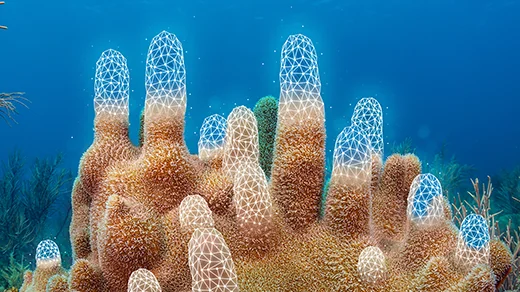
Coral colonies come in an astonishing range of shapes: branching staghorns, flat plates, domed boulders, delicate fans. The variety looks unconstrained, but physicists and marine biologists working together have built a mathematical framework that predicts how a colony's form emerges from the behaviour of individual polyps.
The model treats each polyp as a simple agent following local rules: it builds skeleton in a particular direction, competes with neighbours for space and responds to light and current. When these rules are combined and simulated, the resulting structures closely match the shapes found on real reefs. A small number of parameters can generate the full repertoire.
The work has practical value. Coral morphology determines how colonies withstand waves, capture light and survive bleaching, so being able to predict shape from environmental conditions offers a way to forecast which reefs may persist as the ocean warms. The mathematics is elegant, but its purpose is urgent, and the researchers hope it can guide efforts to breed or transplant corals better suited to the conditions now arriving.