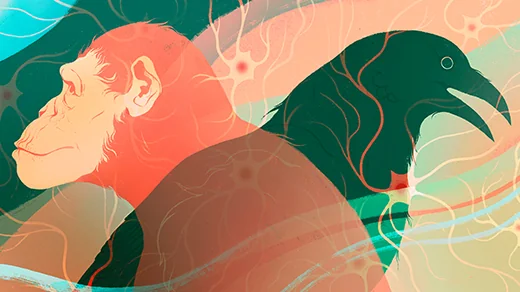
Birds and mammals last shared a common ancestor more than three hundred million years ago, long before either group developed the elaborate forebrains associated with intelligent behaviour. Yet both lineages produce animals capable of tool use, social learning, planning and, in some cases, something that looks very much like insight. A growing body of evidence suggests these abilities arose independently.
The anatomical case is striking. The structures that support complex cognition in birds are organised differently from the mammalian cortex, with a different architecture and different developmental origins, yet they perform comparable functions. Comparisons of gene expression and connectivity point to convergent solutions rather than shared inheritance.
The conclusion is that intelligence is not a single achievement of one lucky lineage but a capacity that evolution can assemble more than once, using whatever materials are available. That reframing has implications for how scientists study cognition, and for how we think about minds that are fundamentally unlike our own, whether they belong to a crow, an octopus or a machine.