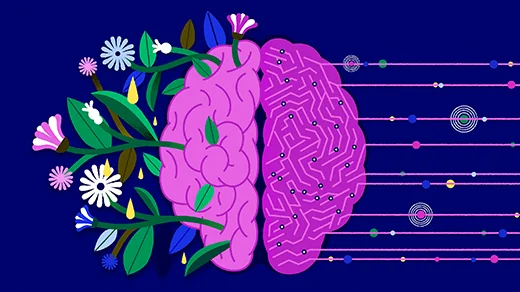
Artificial intelligence is often described in the language of brains: neural networks, learning, memory. The metaphors are convenient and misleading. Machine learning systems differ from biological brains in almost every respect that can be measured, and some researchers argue that the differences are the most interesting thing about them.
Consider scale and diversity. A brain contains thousands of distinct cell types, each with its own chemistry, and its connections are neither uniform nor fixed. Artificial networks use a handful of simple units and adjust numerical weights. A brain runs on about twenty watts; large models consume the output of power stations. A brain learns continuously from sparse data; models are trained once on enormous datasets and then frozen.
These contrasts are not arguments against building better machines. They are a source of design ideas. Researchers looking for more efficient, more adaptable systems are studying how biological tissue achieves so much with so little, and finding that the brain's apparent inefficiencies are often features rather than bugs.