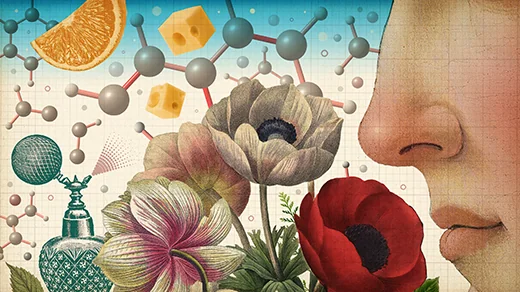
Smell is the sense most directly wired into memory and emotion, and the least understood. Odour molecules drifting into the nose are detected by a large family of receptors, each neuron expressing just one. The resulting pattern of activation is then assembled in the brain into a perception that can trigger a vivid recollection before any words arrive.
New research is filling in the details of both halves of the system. On the input side, scientists are cataloguing which receptors respond to which molecules and how mixtures are encoded. On the neural side, they are tracing how signals from a few thousand glomeruli are transformed into the rich, specific quality of a particular smell.
The work has practical value. Loss of smell is an early symptom of several neurological conditions, and the COVID-19 pandemic made the public acutely aware of how much the sense contributes to daily life. Understanding how the system is organised may eventually help restore it when it fails.