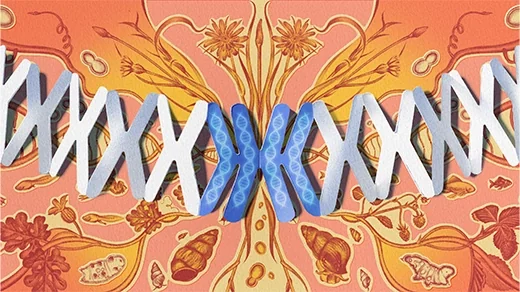
Sometimes, in a single stroke, an organism ends up with two copies of every chromosome instead of one. Whole protein.">genome duplication is a mutation of extraordinary scale, and it has happened repeatedly across the tree of life, in salmon, in wheat, in frogs and in the ancestors of every vertebrate alive today. The event can open evolutionary doors that would otherwise stay shut.
With a spare set of genes, one copy can keep doing its original job while the other accumulates changes. Over millions of years that redundancy becomes raw material: new enzymes, new regulatory circuits, new body plans. Some lineages appear to have used genome doubling to weather mass extinctions, expanding into ecological space left vacant by others.
But the gamble cuts both ways. Extra chromosomes disrupt the delicate balance of proteins that must pair up in precise ratios, and most duplicated genomes collapse within a few generations. Recent studies of polyploid species are beginning to show what separates the survivors from the failures, and the answer seems to lie in how quickly they can silence and repurpose the redundant genes.