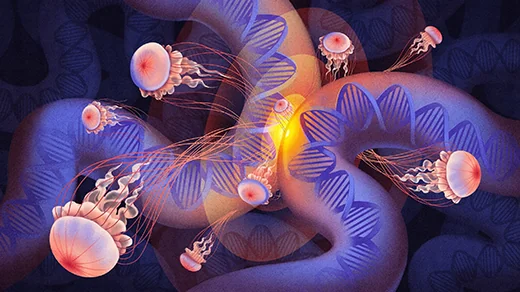
Genomes are long. Stretched out, the DNA in a single human cell would be about two metres across, yet it must fit inside a nucleus a fraction of a millimetre wide, and the sequences that control a gene are often enormous distances away along the strand. Folding solves both problems at once, bringing distant regions into physical contact, and new research suggests this solution is far older than anyone expected.
The mechanism involves motor proteins that extrude loops of DNA, reeling the fibre through a ring until the loop presses against boundary elements that stop it. The result is a series of nested domains, each with its own regulatory landscape. Genes are switched on and off not only by what sits next to them but by what the folding brings close.
Studying the machinery in ancient lineages of archaea and bacteria indicates that the basic capacity to form and regulate loops predates complex life. Rather than being an invention of animals and plants, it looks like an inheritance, one that helped make large, sophisticated genomes manageable in the first place.