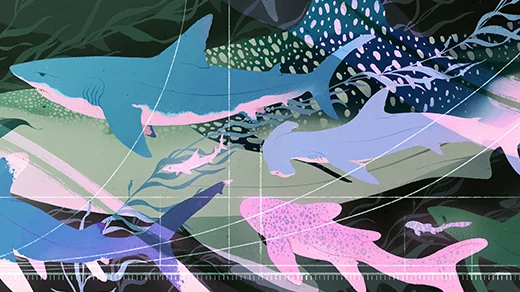
Sharks range from a hand-length species that lives in reef crevices to whale sharks the size of a bus. Their shapes, diets and habitats vary enormously, and yet a large analysis of measurements across the group has found something unexpectedly tidy: their bodies scale in strict geometric proportion. Length, mass and girth rise together in a way that can be described by a simple mathematical relationship.
The pattern is not obvious from casual observation, because species fill very different ecological niches. But when the numbers are plotted, the scatter collapses onto a narrow line. That suggests sharks are constrained by a shared set of physical and physiological limits rather than free to evolve any shape the environment permits.
Similar scaling relationships appear in other animal groups, and researchers argue they reflect fundamental trade-offs: as bodies grow, surfaces and volumes change at different rates, forcing corresponding adjustments in metabolism, feeding and reproduction. Sharks, ancient and diverse, make a particularly clean case study for testing how far those constraints reach.