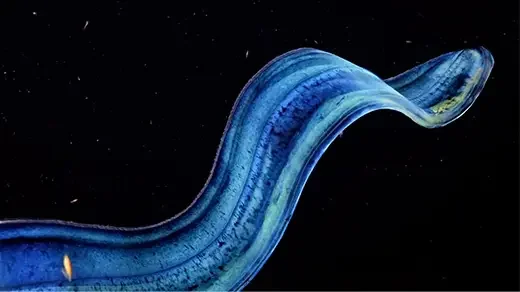
Comb jellies look like creatures from another planet: transparent, gelatinous bodies rowed through the sea by eight bands of shimmering cilia, many of them glowing with their own light. They belong to one of the oldest animal lineages alive, and they sit near the base of the tree that leads to every nerve cell in your head. That position makes them far more important than their delicate appearance suggests.
One puzzle is their nervous system. Comb jellies have neurons, synapses and something resembling a brain, yet the molecules they use look strikingly different from ours. Some researchers read this as evidence that nerves evolved twice, independently, on separate branches of the animal tree. Others argue the lineage simply rewrote its own toolkit after splitting off. Either way, the animals complicate the tidy story that brains evolved once and only once.
Their glow is equally instructive. Bioluminescence has evolved dozens of times across life, and comb jellies offer unusually clean examples of how a light-producing protein can be adapted for signalling, defence and courtship. They are, in short, a living laboratory for some of biology's oldest questions.