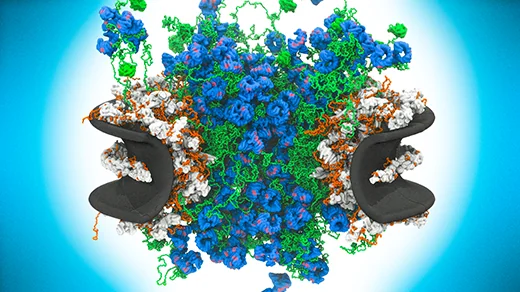
Every second, hundreds to thousands of molecules pass through each nuclear pore in each of your cells, shuttling instructions and materials between the nucleus and the rest of the cell. The pore is one of nature's most intricate machines, built from hundreds of protein copies arranged in a ring. A new high-definition view has captured it in action, and the picture is stranger than expected.
What makes the pore work is disorder. Its central channel is filled with protein segments that have no fixed shape, flopping and writhing like a dense thicket. Small molecules slip through the gaps, while larger cargo needs a molecular passport to be escorted across. The apparent chaos is the mechanism: flexibility allows the channel to admit the right passengers while blocking everything else.
Researchers have long argued about how this selectivity arises, with competing models of how the tangled proteins behave. The new structural data narrows the possibilities and reveals how the ring deforms as cargo moves. Beyond the basic biology, the work matters because failures in nuclear transport are implicated in several neurodegenerative diseases.