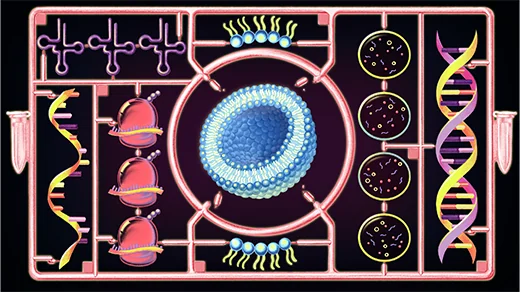
Building a cell from scratch has been a dream, and a cautionary tale, for decades. Now a team has assembled a synthetic cell that combines more lifelike properties than any predecessor: it grows, rearranges its internal structure and divides, all using components that were mixed together in a laboratory rather than inherited from an existing organism.
The achievement rests on giving the artificial cell a working cytoskeleton, the network of protein filaments that lets real cells change shape and pinch in two. Without it, earlier synthetic constructs could carry out reactions but could not reproduce. The new version manages both, suggesting that the minimum requirements for something like independent life are more modest than many expected.
Nobody is claiming this is an organism in the ordinary sense. It cannot evolve, it depends on a carefully maintained environment, and it was designed rather than born. But as a proof of concept it is significant. It sharpens the boundary between nonliving matter and life, and it gives researchers a testbed for asking which properties are truly essential and which are merely inherited habits.